
Integrating Indigenous Wisdom Into Modern Leadership: Principles for Lasting Transformation
- Louise Bremen

- Mar 18
- 4 min read
Updated: Apr 8
Why Indigenous Wisdom, Why Now
Modern organizations are under pressure to grow faster, digitize at scale, and respond to rising stakeholder expectations. Yet many leadership systems remain optimized for short-term performance rather than long-term resilience and relational trust.
Indigenous traditions have sustained complex societies over centuries by centering balance, reciprocity, and interconnectedness rather than extraction and control. These are not historical curiosities; they are practical operating principles for organizations facing polycrisis conditions—climate risk, social polarization, and eroding trust in institutions.
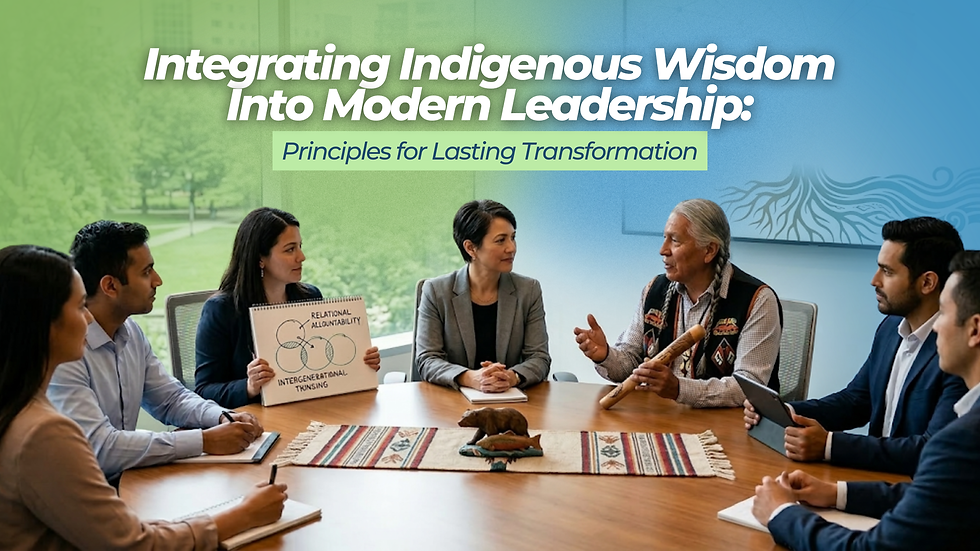
Where conventional leadership models often prioritize efficiency and competition, indigenous approaches emphasize relational accountability, intergenerational thinking, and systemic balance as core decision criteria. For executive teams, this shift reframes leadership from managing outputs to stewarding systems of people, place, and purpose.
The Core Opportunity

Four mutually reinforcing principles are especially relevant for modern organizations:
1. Relational Accountability
Leaders are accountable not only to shareholders or funders, but also to employees, communities, ecosystems, and future generations.
2. Intergenerational Thinking
Decisions are evaluated based on their long-term consequences, not just quarterly results or annual plans.
3. Collective Stewardship
Leadership is shared and distributed, with authority and responsibility held across the community rather than concentrated narrowly at the top.
4. Holistic Systems Awareness
Social, ecological, economic, and spiritual dimensions are understood as interconnected, so interventions consider system-wide impacts, not isolated metrics.
Taken together, these principles create a leadership architecture that aligns organizational power with responsibility, not just performance.
Why This Matters Now
Most organizations today are navigating some combination of these challenges:
Short-term decision pressure driven by markets, funding cycles, or political timelines
Fragmented stakeholder relationships that erode trust and slow execution
Cultural polarization within and around the organization
Sustainability risks that threaten long-term viability
Indigenous leadership principles counterbalance these dynamics by building systemic responsibility into how decisions are framed and made. When leaders adopt longer time horizons, expand their circle of accountability, and treat relationships as strategic assets, organizations are better positioned to manage risk, retain talent, and maintain legitimacy with their stakeholders.
For boards and senior teams, this is not about replacing existing strategy or governance frameworks. It is about widening the lens so that growth, impact, and equity are pursued in integrated rather than competing ways.
From Principle to Practice: An Integration Roadmap

Integrating indigenous wisdom into organizational practice must be done with rigor, humility, and respect. The goal is partnership, not appropriation.
Leading organizations are beginning to:
Bring indigenous voices into governance: Invite indigenous leaders, elders, or knowledge holders into advisory or governance roles, with appropriate compensation and authority.
Embed relational dialogue: Incorporate listening circles and storytelling-based dialogue into strategic planning, change management, and employee engagement.
Translate acknowledgment into action: Move beyond symbolic land acknowledgments to concrete commitments tied to strategy, philanthropy, or community investment.
Broaden performance dashboards: Embed sustainability and relational metrics alongside financial KPIs in performance dashboards and executive scorecards.
Build reciprocal partnerships: Create long-term, mutually beneficial relationships with indigenous communities, rather than one-off initiatives or transactional engagement.
Authentic integration requires leaders to practice humility: to listen before acting, to recognize lineage and historical context, and to be transparent about what they are learning and where they are still falling short.
Where Impact Shows Up
The most powerful impact of indigenous leadership principles often emerges not in slogans but in day-to-day operating choices:
Area of Application | What Changes |
Community-centered strategy design | Engaging employees, partners, and community stakeholders early and often in defining priorities and trade-offs |
Restorative conflict resolution | Using restorative practices that focus on repair, relationship, and learning rather than solely on blame or compliance |
Participatory governance models | Designing forums where decision rights are shared more broadly, especially on issues that directly affect frontline staff or communities |
Long-term sustainability planning | Treating environmental and social commitments as integral to enterprise strategy, not as peripheral ESG projects |
Table 1: Indigenous Leadership Principles in Action
Organizations that make these shifts often report strengthened trust, deeper cultural cohesion, and greater alignment between espoused values and lived experience.
The Path Forward

Indigenous wisdom is not a trend or a corporate initiative to be checked off a list. It represents a fundamental reorientation of how leaders think about power, accountability, and what constitutes value creation.
For organizations ready to move from aspiration to practice, this work requires:
Strategic clarity about why this matters to your mission and stakeholders
Authentic partnership with indigenous knowledge holders and community partners
Structural change that embeds relational and sustainability thinking into core decision processes
Leadership commitment that models these principles visibly and consistently
Bridging International partners with leaders and organizations ready to make this transition—connecting indigenous wisdom, equity-centered design, and adaptive leadership to build cultures of responsibility, respect, and resilience.
The most competitive advantage for leaders in complex times is no longer efficiency alone. It is the capacity to steward relationships, systems, and futures.
About Bridging International
Bridging International is a consulting firm specializing in transformational change, adaptive leadership, and equity-centered organizational development. We work with nonprofit leaders, executive teams, and boards to integrate indigenous wisdom, systems thinking, and relational accountability into strategy, governance, and culture.
Learn more at www.bridginginternational.com


Comments